
How to Design Cryptographically Secure Passwords: Entropy and Strength Math
Discover the mathematics of password entropy, learn why length outperforms character complexity, and explore how Web Crypto APIs generate secure keys.
🔧 Interactive Utility Tool
Try the free, 100% secure client-side tool associated with this guide. No registration required.
How to Design Cryptographically Secure Passwords: Entropy Math
Securing user accounts requires state-of-the-art hashing algorithms and entropy measures. Here is how passwords are secured.
A cryptographic password is a secure key verified using hashing algorithms (like bcrypt) and unique random salt values. Checking password complexity entropy ensures the credentials resist modern high-speed brute-force attacks.
Brute-force attacks are faster and more automated than ever before. To protect user accounts and sensitive database structures, understanding the mathematics of Password Entropy is critical. Many legacy password policies force users to mix numbers and symbols into short words (e.g. P@ssw0rd!), resulting in values that are difficult for humans to remember but trivial for modern GPU rigs to crack.
In this guide, we'll cover password entropy mathematics, explain the Web Cryptography API, and display a visual password strength chart.
Product-Led CTA: Never reuse passwords or store them in unsafe web browsers. Generate high-entropy, cryptographically secure keys instantly using our secure, client-side Secure Password Generator.
📐 The Mathematics of Password Entropy
Password entropy is a mathematical measure of a password's unpredictability, calculated in bits. The higher the entropy score, the more random trials a brute-force script must execute to crack the code.
The formula for password entropy is:
$$E = L \times \log_2(R)$$
Where: * $E$: Entropy in bits. * $L$: The length of the password (number of characters). * $R$: The size of the character pool (charset range).
Charset Pools ($R$):
- Numbers only: $R = 10$ (0-9)
- Lowercase letters: $R = 26$ (a-z)
- Alphanumeric mixed case: $R = 62$ (a-z, A-Z, 0-9)
- Full special symbols: $R = 94$ (alphanumeric + symbols)
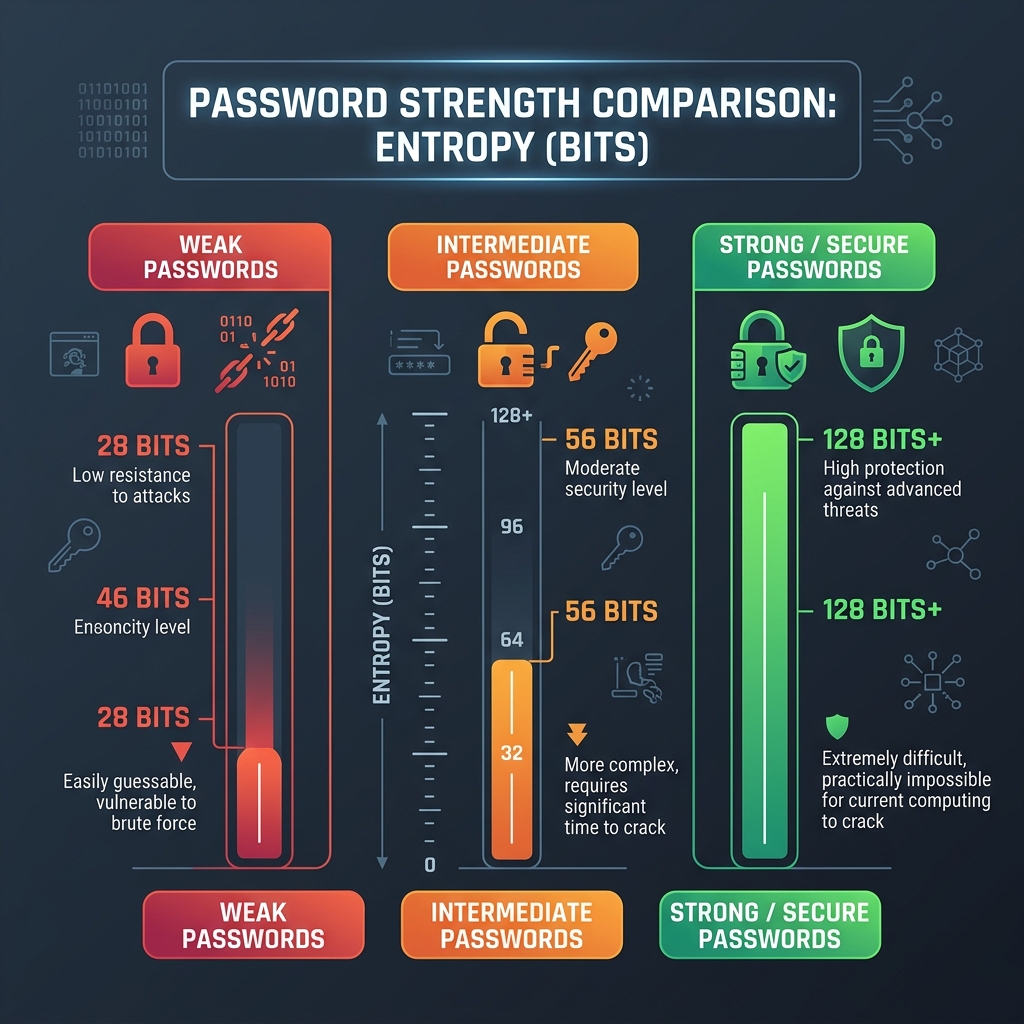
📊 Password Strength and Entropy Infographic
Below is a visual layout detailing how entropy levels dictate cracking resistance:
⚡ Quick Action: Use the Online Tool
This guide pairs with our free, 100% secure client-side utility tool. Process your files or text instantly in-browser.
🧪 Why Length Beats Character Complexity
Let's compare two different password profiles to see why adding length is vastly superior to adding special characters:
- Short & Complex: A 9-character password using the full symbol set (
K7#p$29!q): $$E = 9 \times \log_2(94) \approx 9 \times 6.55 \approx \mathbf{59.0 \text{ bits}}$$ - Long & Simple: A 16-character password using only lowercase letters (
bluepandarunning): $$E = 16 \times \log_2(26) \approx 16 \times 4.70 \approx \mathbf{75.2 \text{ bits}}$$
Even though the second password uses a much smaller character pool (no numbers, capitals, or symbols), it is over 65,000 times harder to crack because the mathematical exponent of length scales the total possibilities exponentially.
💻 Generating Secure Values via Web Cryptography API
In client-side JavaScript, developers often use Math.random() to generate codes. However, Math.random() is a pseudo-random generator whose seed can be reverse-engineered by observers.
For cryptographically secure generation, use the browser's native Web Cryptography API:
```javascript function generateSecureRandomString(length, chars = "abcdefghijklmnopqrstuvwxyzABCDEFGHIJKLMNOPQRSTUVWXYZ0123456789") { const bytes = new Uint8Array(length); // Fills the array with cryptographically strong pseudo-random values window.crypto.getRandomValues(bytes);
let result = ""; for (let i = 0; i < length; i++) { result += chars[bytes[i] % chars.length]; } return result; } ```
To learn more about secure data formats, check out our Web Cryptography API Guide.
For users seeking instant, high-entropy keys, use our browser-based Secure Password Generator which utilizes this exact API locally. If you're concerned about data processing, you can read our Privacy Policy to confirm that no inputs or outputs are ever saved on a server.
Join the Urbandigistore Hub
Subscribe to receive premium developer cheat sheets, advanced conversion techniques, and campaign optimization checklists. Zero spam, unsubscribe anytime.
🚀 Launch Interactive Tool
Ready to test this directly? Open the secure web tool in a new sandbox tab.