
Why Password Length Outperforms Complexity: The Entropy Exponent
Explore the mathematical proof demonstrating why password length scales cracking resistance exponentially faster than character complexity.
🔧 Interactive Utility Tool
Try the free, 100% secure client-side tool associated with this guide. No registration required.
Why Password Length Outperforms Complexity: The Exponent
Securing user accounts requires state-of-the-art hashing algorithms and entropy measures. Here is how passwords are secured.
A cryptographic password is a secure key verified using hashing algorithms (like bcrypt) and unique random salt values. Checking password complexity entropy ensures the credentials resist modern high-speed brute-force attacks.
Standard IT password rules often force users to create short, complex passwords (e.g. Tr0$t!). These guidelines assume that adding symbols is the best way to secure accounts. In cryptanalysis, however, the mathematics of search space calculations prove that password length is vastly superior to character complexity.
In this guide, we'll write out the mathematical proof, analyze guessing times, and show a logarithmic scale chart of password entropy.
Product-Led CTA: Never reuse passwords or store them in unsafe web browsers. Generate high-entropy, cryptographically secure keys instantly using our secure, client-side Secure Password Generator.
📐 The Mathematical Proof: Exponent vs. Base
A brute-force attack is a permutation search. The total size of the search space ($S$) is calculated as:
$$S = R^L$$
⚡ Quick Action: Use the Online Tool
This guide pairs with our free, 100% secure client-side utility tool. Process your files or text instantly in-browser.
Where: * $R$: The size of the character pool (the base). * $L$: The length of the password (the exponent).
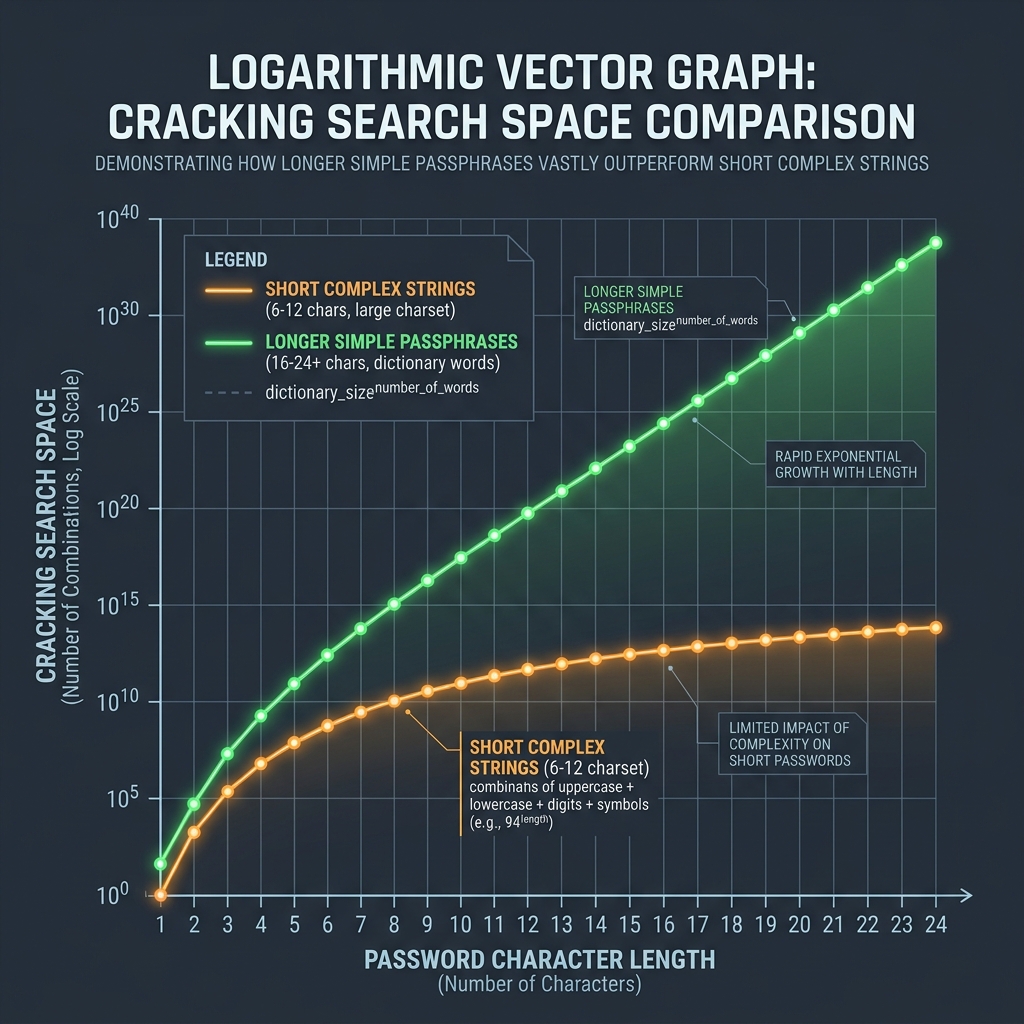
Because length is the exponent, changing the value of $L$ scales the search space exponentially faster than changing the value of $R$ (the base).
📊 Password Guessing Search Space Chart
Below is a logarithmic scale graph illustrating how longer, simple passphrases create an exponentially larger search space compared to short, complex strings:
🔍 Comparative Analysis: Complexity vs. Length
Let's look at the mathematical outcomes of two different password profiles:
Profile A: Short and Highly Complex (8 characters, full charset)
- Charset ($R$): Alphanumeric + Symbols = 94 characters.
- Length ($L$): 8 characters.
- Total Combinations: $$94^8 \approx 6.09 \times 10^{15} \text{ combinations}$$
- Entropy: $\approx 52.4 \text{ bits}$.
Profile B: Long and Simple (20 characters, lowercase letters only)
- Charset ($R$): Lowercase letters = 26 characters.
- Length ($L$): 20 characters.
- Total Combinations: $$26^{20} \approx 1.99 \times 10^{28} \text{ combinations}$$
- Entropy: $\approx 94.0 \text{ bits}$.
Profile B is $3.2 \times 10^{12}$ (over 3 trillion) times harder to crack than Profile A, despite using a much simpler pool of characters. Long passphrases (like correcthorsebatterystaple) are both easier for humans to remember and mathematically impossible for modern computing systems to brute force.
🛡️ Generating Strong Passwords Locally
To secure your systems: 1. Enforce Passphrases: Shift policies away from character complexity rules toward a minimum length constraint (e.g. 16+ characters). 2. (See our detailed Password Entropy Math Guide to review bits calculation formulas). 3. Generate Secure Keys: Use our browser-only Secure Password Generator to calculate high-entropy keys. Since all calculations execute in client-side memory, your keys are never sent to a database. (Read our Privacy Policy for data safety guarantees).
Join the Urbandigistore Hub
Subscribe to receive premium developer cheat sheets, advanced conversion techniques, and campaign optimization checklists. Zero spam, unsubscribe anytime.
🚀 Launch Interactive Tool
Ready to test this directly? Open the secure web tool in a new sandbox tab.