
Why Password Hashing Requires Salt: Preventing Precomputed Dictionary Attacks
Learn how password salting works and why appending random seeds before hashing prevents precomputed dictionary and rainbow table attacks.
🔧 Interactive Utility Tool
Try the free, 100% secure client-side tool associated with this guide. No registration required.
Why Password Hashing Requires Salt: Stopping Dict Attacks
Securing user accounts requires state-of-the-art hashing algorithms and entropy measures. Here is how passwords are secured.
A cryptographic password is a secure key verified using hashing algorithms (like bcrypt) and unique random salt values. Checking password complexity entropy ensures the credentials resist modern high-speed brute-force attacks.
When storing user credentials in a database, security best practices dictate that passwords should never be stored in plain text. Instead, they are passed through a cryptographic hash function (like bcrypt, Argon2, or SHA-256) to generate a fixed-size signature. However, if you hash passwords directly without adding a Salt, the database remains vulnerable to precomputed dictionary attacks.
In this guide, we'll explain dictionary attacks, trace the salting mechanism, and outline entropy rules.
Product-Led CTA: Never reuse passwords or store them in unsafe web browsers. Generate high-entropy, cryptographically secure keys instantly using our secure, client-side Secure Password Generator.
⚙️ The Threat of Precomputed Dictionary Attacks
Hash functions are deterministic—the same input password will always produce the exact same output hash. If two users choose the same password (e.g., 123456), their stored hashes in the database will be identical.
⚡ Quick Action: Use the Online Tool
This guide pairs with our free, 100% secure client-side utility tool. Process your files or text instantly in-browser.
Attackers exploit this determinism using two primary methods: 1. Dictionary Attacks: The attacker hashes a list of common words and phrases, comparing them against stolen database hashes. 2. Rainbow Tables: Attackers pre-compute millions of password hashes in advance and store them in massive lookup tables. When a database is breached, the attacker simply runs a database lookup to reverse the hashes instantly.
📊 Password Length and Complexity Reference
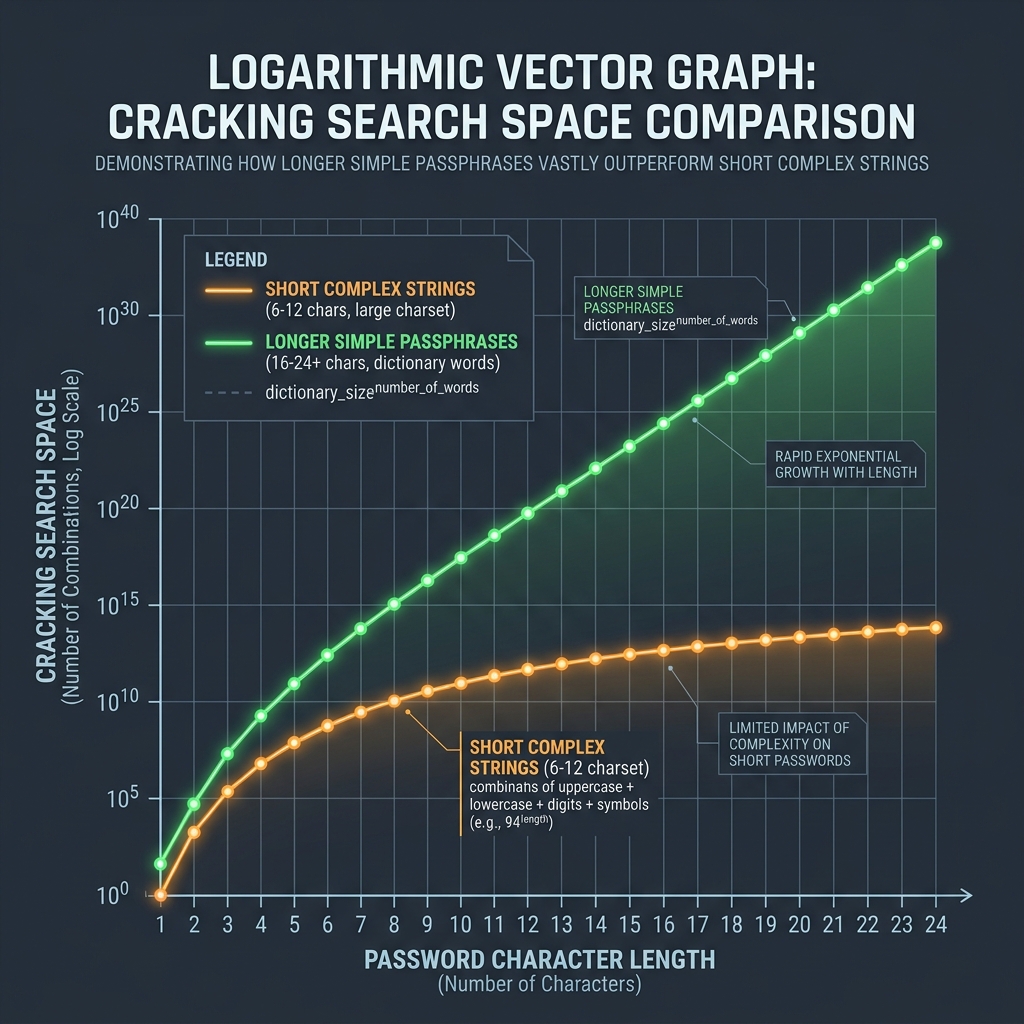
Using strong, random salts is critical. To see how password length and search space sizes scale brute-force difficulty, refer to the logarithmic chart below:
🛡️ How Salting Defeats Precomputation
A salt is a cryptographically random string appended to the user's password before the hashing function is applied:
$$\text{Stored Hash} = \text{Hash}(\text{Password} + \text{Salt})$$
By using a unique, random salt for every user: * Unique Hashes: If two users choose the same password, their unique salts ensure that their stored hashes are completely different. * Renders Rainbow Tables Useless: Because the salt is unique for every user account, attackers cannot pre-compute rainbow tables. They must brute-force each account's hash individually, increasing cracking costs. * (Read our Password Hashing and Rainbow Table Salting Guide to review database protections). * Generate High-Entropy Keys: Use our browser-only Secure Password Generator to create custom keys. Since all calculations execute in client-side memory, your keys are never sent to a database. (Read our Privacy Policy for data safety guarantees).
Join the Urbandigistore Hub
Subscribe to receive premium developer cheat sheets, advanced conversion techniques, and campaign optimization checklists. Zero spam, unsubscribe anytime.
🚀 Launch Interactive Tool
Ready to test this directly? Open the secure web tool in a new sandbox tab.