
Why Password Hashing Requires Salt: Defending Against Rainbow Tables
Discover how cryptographic salting protects hashed passwords against dictionary attacks and rainbow tables.
🔧 Interactive Utility Tool
Try the free, 100% secure client-side tool associated with this guide. No registration required.
Why Password Hashing Requires Salt: Defending Vaults
Securing user accounts requires state-of-the-art hashing algorithms and entropy measures. Here is how passwords are secured.
A cryptographic password is a secure key verified using hashing algorithms (like bcrypt) and unique random salt values. Checking password complexity entropy ensures the credentials resist modern high-speed brute-force attacks.
If a database stores passwords in plain text, any security breach results in total compromise. To prevent this, developers store passwords as cryptographic hashes using one-way algorithms (like SHA-256 or bcrypt). However, if two users have the same password, they will have the same hash. This allows attackers to decrypt entire databases using pre-computed lookup catalogs called Rainbow Tables.
The defense against this vulnerability is Cryptographic Salting. In this guide, we'll explain how salting works, trace lookup attack patterns, and review secure hashing rules.
Product-Led CTA: Never reuse passwords or store them in unsafe web browsers. Generate high-entropy, cryptographically secure keys instantly using our secure, client-side Secure Password Generator.
📐 What is a Cryptographic Salt?
A salt is a unique, randomly generated string appended to the user's password before it passes through the hashing function:
⚡ Quick Action: Use the Online Tool
This guide pairs with our free, 100% secure client-side utility tool. Process your files or text instantly in-browser.
$$\text{Stored Hash} = \text{Hash}(\text{Password} + \text{Salt})$$
When the user registers:
1. The server generates a random salt (e.g., 8f9c2d1b).
2. The salt is concatenated with the password.
3. The combined string is hashed and stored in the database along with the plaintext salt.
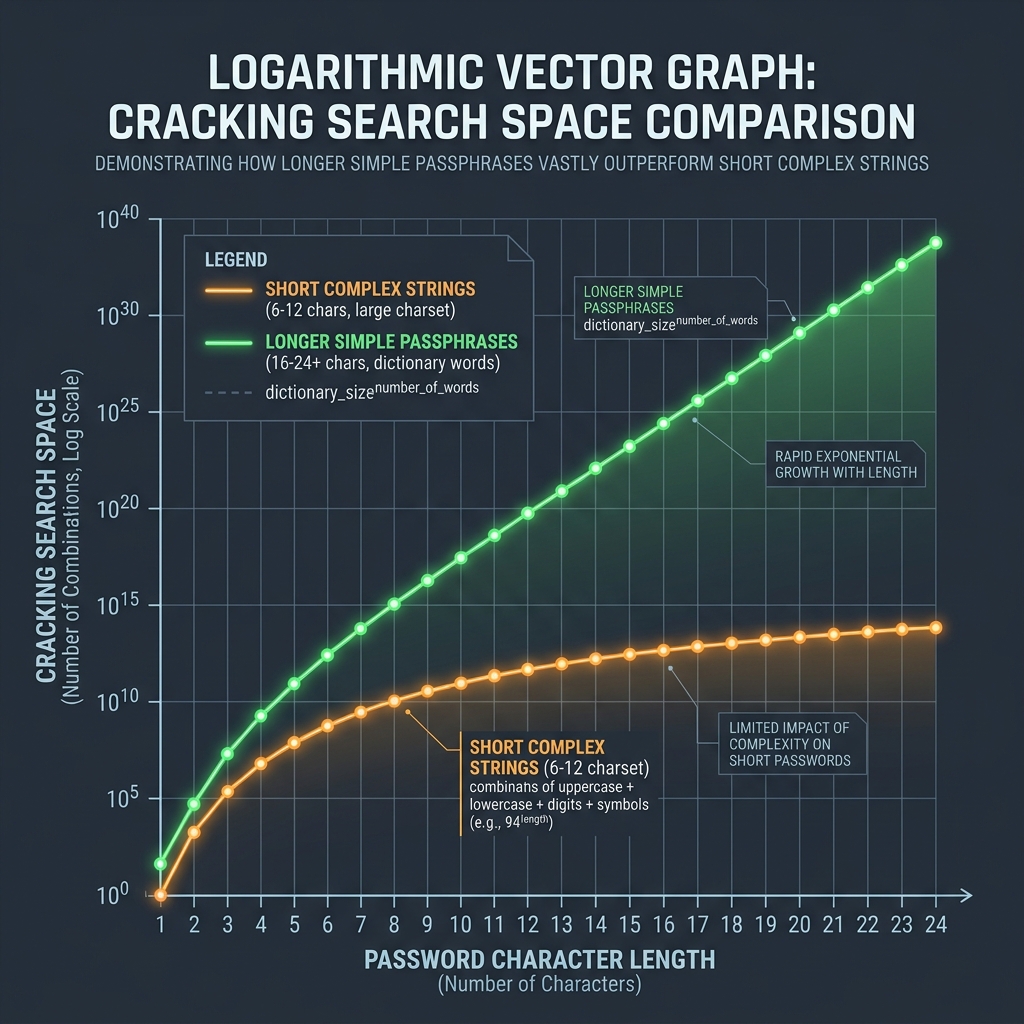
📊 Password Strength and Search Space Reference
Salting secures the hash from lookup tables, but the user must still supply a strong, high-entropy password. Refer to the logarithmic scale chart below to see how length scales cracking difficulty:
🛡️ How Salts Defeat Rainbow Tables
Rainbow tables contain pre-computed hashes for billions of common passwords. When an attacker steals a database of unsalted hashes: * They can compare the stolen hashes against the table to decrypt common passwords instantly. * With Salting: Because every user has a unique salt, the attacker would have to build a custom rainbow table for every individual user's salt. This renders pre-computed tables useless and forces hackers to perform slow, expensive brute-force computations on single accounts.
⚙️ Modern Volatile Hashing Standards
Avoid legacy algorithms like MD5 or SHA-1, which are fast enough to brute force easily. Instead, use memory-hard hashing algorithms:
- Argon2id: The current industry standard. Allows developers to set memory and time cost factors to throttle automated GPU attacks.
- bcrypt: Automatically handles salt generation and key derivation natively inside the library.
- To calculate password length recommendations, read Why Password Length Outperforms Complexity. To review bits calculations, see Password Entropy Mathematics.
- Generate Strong Keys: Use our browser Secure Password Generator to create random keys. All generation runs in client-side memory.
Join the Urbandigistore Hub
Subscribe to receive premium developer cheat sheets, advanced conversion techniques, and campaign optimization checklists. Zero spam, unsubscribe anytime.
🚀 Launch Interactive Tool
Ready to test this directly? Open the secure web tool in a new sandbox tab.