
Why Password Hashing Requires Salt: Preventing Precomputed Rainbow Table Lookups
Learn how password salts work and why appending unique random strings prevents precomputed rainbow table lookups from cracking databases.
🔧 Interactive Utility Tool
Try the free, 100% secure client-side tool associated with this guide. No registration required.
Why Hashing Requires Salt: Stopping Rainbow Lookups
Securing user accounts requires state-of-the-art hashing algorithms and entropy measures. Here is how passwords are secured.
A cryptographic password is a secure key verified using hashing algorithms (like bcrypt) and unique random salt values. Checking password complexity entropy ensures the credentials resist modern high-speed brute-force attacks.
Storing password hashes instead of plain text protects user credentials. However, plain hashes are still vulnerable to precomputed lookup attacks. If an attacker accesses a database containing plain SHA-256 or MD5 hashes, they don't need to guess the passwords. Instead, they can use precomputed databases—called Rainbow Tables—to reverse the hashes instantly. To prevent this, developers use unique Password Salts.
In this guide, we'll explain how rainbow table lookups work, trace the salting mechanism, and analyze security rules.
Product-Led CTA: Never reuse passwords or store them in unsafe web browsers. Generate high-entropy, cryptographically secure keys instantly using our secure, client-side Secure Password Generator.
⚙️ How Precomputed Rainbow Table Lookups Work
Rainbow tables are optimized lookup databases that trade memory storage space for CPU processing time.
⚡ Quick Action: Use the Online Tool
This guide pairs with our free, 100% secure client-side utility tool. Process your files or text instantly in-browser.
- The Precomputation: Attackers run hash functions on billions of common passwords and character combinations in advance.
- The Reduction Function: To save disk space, tables use reduction functions to compress long chains of hashes into simple start-and-end value pairs.
- Instant Reversing: When a database is breached, the attacker looks up the stolen hashes in the rainbow table. If a match is found, the table reveals the corresponding plain-text password in seconds.
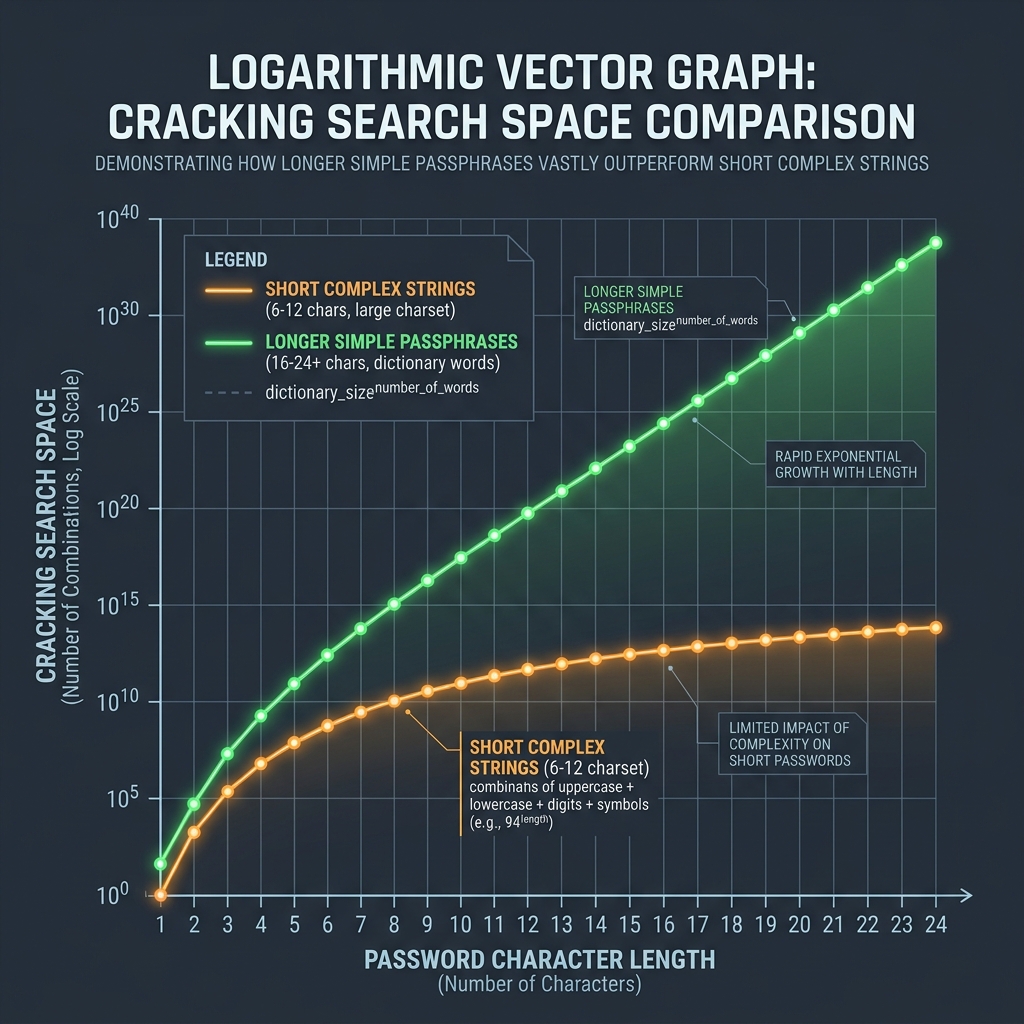
📊 Password Length and Complexity Reference
Using strong, random salts is critical. To see how password length and search space sizes scale brute-force difficulty, refer to the logarithmic chart below:
🛡️ How Salting Prevents Precomputed Lookups
A salt is a cryptographically random string appended to the user's password before hashing:
$$\text{Stored Hash} = \text{Hash}(\text{Password} + \text{Salt})$$
By generating a unique, random salt for every user: * Destroys Precomputations: Even if two users share the same password, their unique salts ensure that their stored hashes are completely different. * Requires Custom Cracking: Because the salt is unique, attackers cannot use pre-existing rainbow tables to decrypt the hashes. They must compute a brand-new set of hashes for each individual salt, making bulk decryption computationally impractical. * (Read our Password Hashing and Rainbow Table Salting Guide to review database protections). * Generate High-Entropy Keys: Use our browser-only Secure Password Generator to create custom keys. Since all calculations execute in client-side memory, your keys are never sent to a database. (Read our Privacy Policy for data safety guarantees).
Join the Urbandigistore Hub
Subscribe to receive premium developer cheat sheets, advanced conversion techniques, and campaign optimization checklists. Zero spam, unsubscribe anytime.
🚀 Launch Interactive Tool
Ready to test this directly? Open the secure web tool in a new sandbox tab.