
Why Password Salts Must Be Cryptographically Random: CSPRNGs Explained
Learn why password salts must be generated using cryptographically secure pseudorandom number generators (CSPRNGs) rather than standard random genera...
🔧 Interactive Utility Tool
Try the free, 100% secure client-side tool associated with this guide. No registration required.
Why Password Salts Must Be Cryptographically Random
Securing user accounts requires state-of-the-art hashing algorithms and entropy measures. Here is how passwords are secured.
A cryptographic password is a secure key verified using hashing algorithms (like bcrypt) and unique random salt values. Checking password complexity entropy ensures the credentials resist modern high-speed brute-force attacks.
Using cryptographic salts is essential to protect password hashes from pre-computed rainbow table attacks. However, simply adding a salt is not enough. If the salt values are generated using a standard pseudorandom number generator (PRNG)—such as JavaScript's Math.random() or Python's random module—the security of the entire database is compromised. Salts must be generated using Cryptographically Secure Pseudorandom Number Generators (CSPRNGs).
In this guide, we'll explain PRNG predictability, detail CSPRNG entropy sources, and analyze security rules.
Product-Led CTA: Never reuse passwords or store them in unsafe web browsers. Generate high-entropy, cryptographically secure keys instantly using our secure, client-side Secure Password Generator.
⚡ Quick Action: Use the Online Tool
This guide pairs with our free, 100% secure client-side utility tool. Process your files or text instantly in-browser.
⚙️ The Vulnerability of Standard PRNGs
Standard programming language random functions (like Math.random()) are designed for speed and statistical uniformity, not security. They use algorithms (like LCG or Mersenne Twister) that rely on a internal state:
- State Reconstruction: If an attacker can observe a sequence of generated salts, they can reverse-engineer the PRNG's internal state.
- Predicting Future Salts: Once the state is reconstructed, the attacker can predict all future salts that will be generated by the server.
- Pre-computing Rainbow Tables: By predicting the salts, the attacker can pre-compute rainbow tables for future user registrations before the database is even breached.
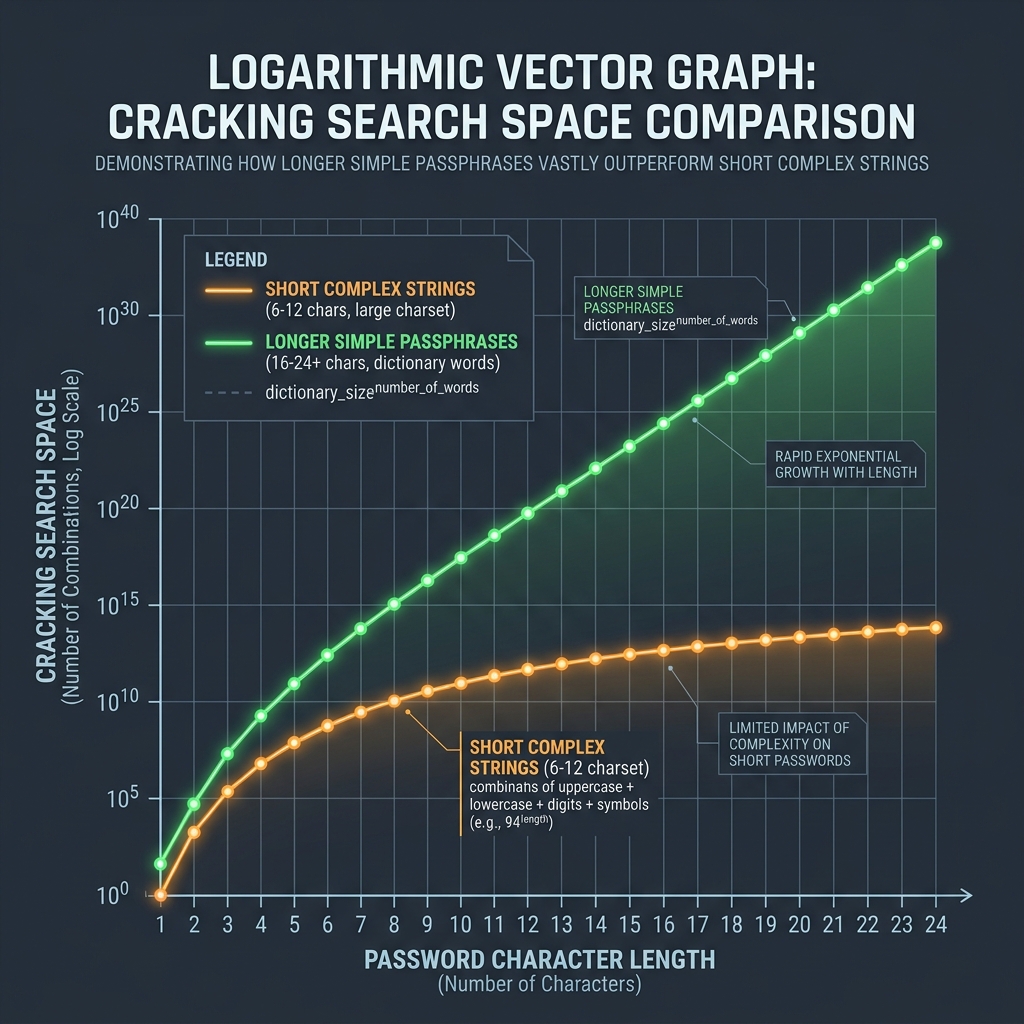
📊 Password Length and Entropy Reference
In addition to using secure salts on the server, passwords must have high entropy. Refer to the logarithmic scale chart below to see how length scales cracking difficulty:
🛡️ CSPRNGs: Cryptographically Secure Randomness
CSPRNGs (such as JavaScript's crypto.getRandomValues() or Python's secrets module) prevent prediction by incorporating high-entropy system noise into their state calculations:
- Entropy Sources: They gather noise from hardware interrupts, mouse movements, disk seek times, and thermal sensors.
- Forward Secrecy: If an attacker manages to compromise the current state of a CSPRNG, they still cannot calculate past or future generated values.
- (Read our Rainbow Table Salting Defenses Guide to review database protections).
- Generate High-Entropy Keys: Use our browser-only Secure Password Generator to create custom keys. Since all calculations execute in client-side memory, your keys are never sent to a database. (Read our Privacy Policy for data safety guarantees).
Join the Urbandigistore Hub
Subscribe to receive premium developer cheat sheets, advanced conversion techniques, and campaign optimization checklists. Zero spam, unsubscribe anytime.
🚀 Launch Interactive Tool
Ready to test this directly? Open the secure web tool in a new sandbox tab.