
Demystifying QR Code Mask Penalty Calculation: The Mathematical Evaluation Metrics
Learn about the mathematical formulas used to calculate QR code mask penalties (N1 to N4) and optimize scanning speeds.
🔧 Interactive Utility Tool
Try the free, 100% secure client-side tool associated with this guide. No registration required.
Demystifying QR Code Mask Penalty Calculations
Deploying custom QR codes in campaigns requires strict adherence to scanner specifications. Here is how grid contrast works.
A QR Code is a two-dimensional barcode storing data inside a grid of dark and light modules. Scanners decode this grid using error-correction math, allowing for fast scannability even when the code is partially damaged.
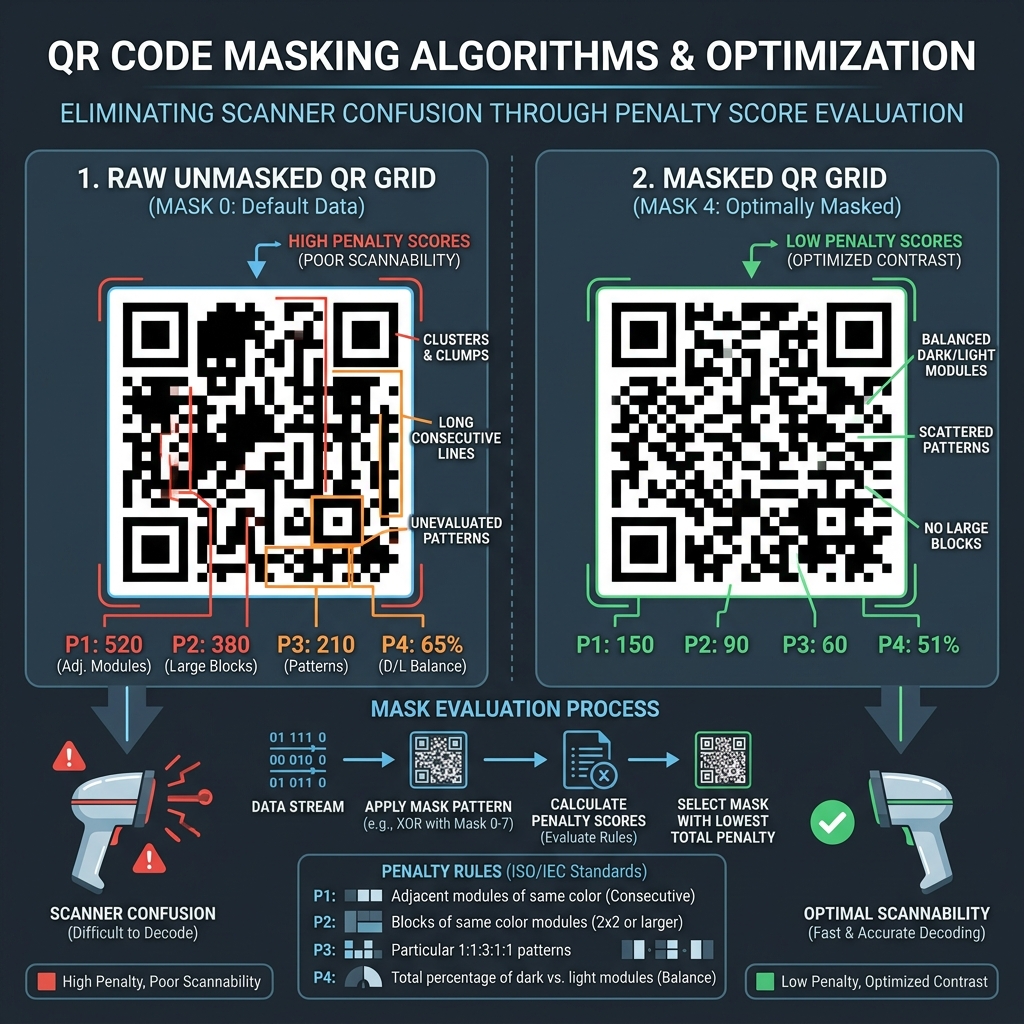
During QR code generation, the encoder applies eight different masking patterns to the data grid to distribute modules evenly and prevent scanning errors. To select the best mask, the generator calculates a Penalty Score for each pattern. The mask that produces the lowest penalty score is chosen for the final code.
In this guide, we'll write out the mathematical formulas for the four ISO/IEC penalty evaluation rules (N1 to N4).
Product-Led CTA: Creating scannable QR codes requires compliant borders and high contrast. Generate web-ready graphics instantly using our free, browser-based Custom QR Code Generator with custom error correction.
📐 The Four Penalty Evaluation Metrics
The generator evaluates the grid module layout against these four penalty rules:
📊 QR Code Masking Optimization Reference
Below is a scannability infographic demonstrating how penalty scores evaluate a raw unmasked grid versus an optimally masked grid layout:
⚡ Quick Action: Use the Online Tool
This guide pairs with our free, 100% secure client-side utility tool. Process your files or text instantly in-browser.
🔢 1. Penalty N1 (Consecutive Modules)
Penalizes horizontal or vertical runs of modules of the same color. For each run of $5$ or more consecutive modules:
$$\text{Penalty N1} = \sum (\text{Number of runs} \times 3) + (\text{Excess modules over 5} \times 1)$$
🔢 2. Penalty N2 (Blocks of Color)
Penalizes solid blocks of the same color. For each block of size $2 \times 2$ modules or larger:
$$\text{Penalty N2} = (\text{Width} - 1) \times (\text{Height} - 1) \times 3$$
🔢 3. Penalty N3 (Finder-like Patterns)
Penalizes patterns that resemble the finder patterns (which can confuse the scanner's search orientation). The specific target pattern is a run of:
* Dark - Light - Dark - Dark - Dark - Light - Dark (ratio 1:1:3:1:1), surrounded by a 4-module quiet zone of light modules on either side.
* Cost: Each occurrence adds 40 points to the penalty score.
🔢 4. Penalty N4 (Dark/Light Balance)
Penalizes grids where the total ratio of dark modules deviates significantly from 50%. The calculation steps are:
- Calculate the percentage of dark modules: $P = (\text{Dark Modules} / \text{Total Modules}) \times 100$.
- Find the absolute difference from 50%, rounded down to the nearest multiple of 5: $$D = \lfloor |P - 50| / 5 \rfloor \times 5$$
- Calculate the penalty: $$\text{Penalty N4} = (D / 5) \times 10$$
🎨 Best Practices for Styling Custom Codes
To ensure high scanning reliability: * Keep Data Densities Low: Shorten urls using a Campaign UTM Generator first, then shorten the link. * (See our QR Code Naming & Campaign Tracking Guide for details). * Quiet Zone Border: Ensure a clear border margin is maintained on all sides. (See QR Code Quiet Zones Guide). * Create Custom QR Codes: Paste your link into our browser-based Custom QR Code Generator to select error correction levels and compile clean, scannable files.
Join the Urbandigistore Hub
Subscribe to receive premium developer cheat sheets, advanced conversion techniques, and campaign optimization checklists. Zero spam, unsubscribe anytime.
🚀 Launch Interactive Tool
Ready to test this directly? Open the secure web tool in a new sandbox tab.