
Demystifying QR Code Quiet Zones: Contrast Requirements for Optical Scanning
Learn how the color contrast between a QR code quiet zone and surrounding graphics affects optical scanner recognition rates.
🔧 Interactive Utility Tool
Try the free, 100% secure client-side tool associated with this guide. No registration required.
Demystifying QR Code Quiet Zones: Contrast Requirements
Deploying custom QR codes in campaigns requires strict adherence to scanner specifications. Here is how grid contrast works.
A QR Code is a two-dimensional barcode storing data inside a grid of dark and light modules. Scanners decode this grid using error-correction math, allowing for fast scannability even when the code is partially damaged.
When designing marketing assets, it is not enough to maintain a clear margin (the Quiet Zone) around your QR code. The color contrast of that boundary is equally important. If the quiet zone does not provide sufficient contrast against the surrounding graphics, scanning software will fail to identify the code.
Product-Led CTA: Creating scannable QR codes requires compliant borders and high contrast. Generate web-ready graphics instantly using our free, browser-based Custom QR Code Generator with custom error correction.
⚡ Quick Action: Use the Online Tool
This guide pairs with our free, 100% secure client-side utility tool. Process your files or text instantly in-browser.
📐 Quiet Zone Contrast Rules
To ensure reliable scanning, the Quiet Zone must follow the same contrast rules as the QR code's background: * Color Matching: The Quiet Zone must be a solid color that matches the lighter modules of the QR code (typically white). * Luminance Difference: The reflection difference between the quiet zone and the surrounding asset background must satisfy: $$R_{\text{light}} - R_{\text{dark}} \geq 0.15$$ * Avoid Overlapping Gradients: If you place a QR code on a dark or patterned background, you must extend a solid light quiet zone around the entire code to prevent background leakage.
📊 Quiet Zone Alignment Reference
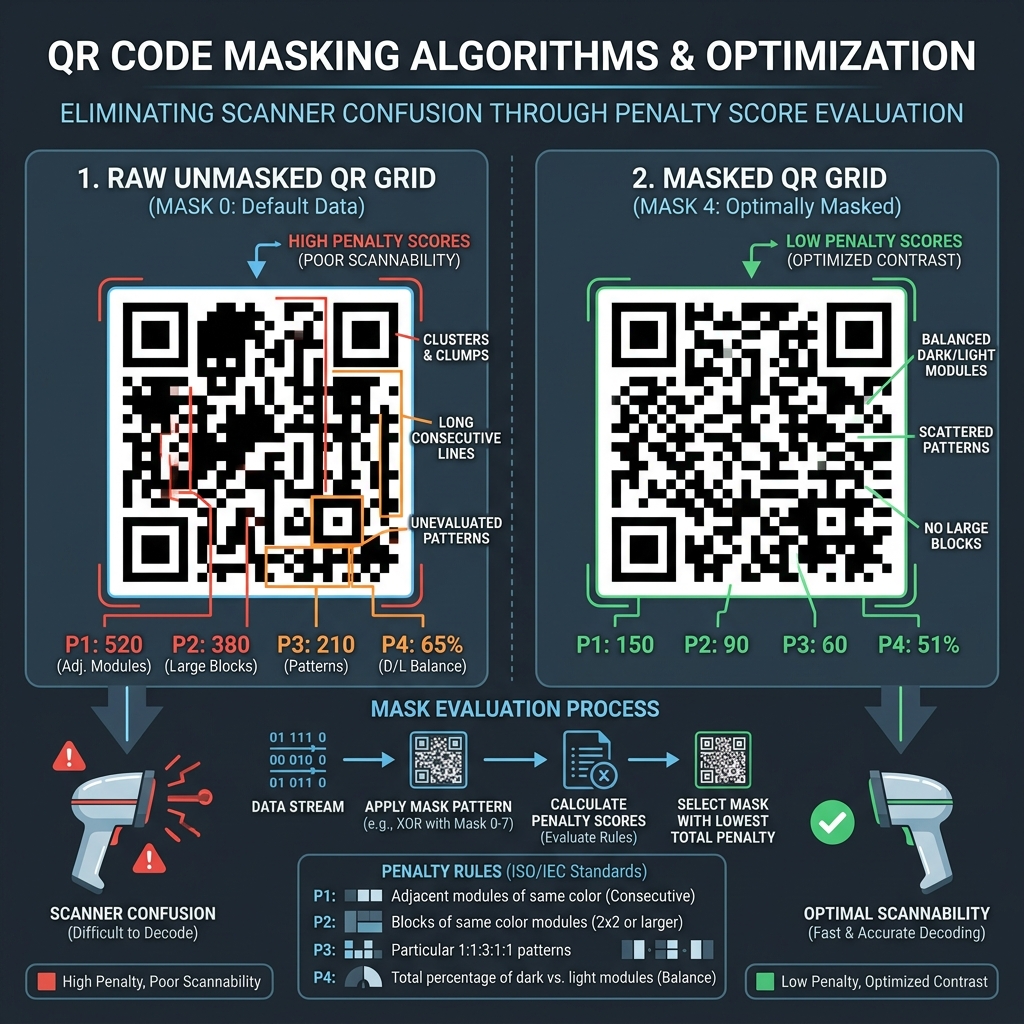
Below is a layout illustrating quiet zone boundaries and finder patterns:
🛡️ Best Practices for Scan Reliability
To make sure your codes scan successfully: * Keep borders clean: Ensure no borders, shadows, or text bleed into the Quiet Zone. * Shorten URL lengths: High-density QR codes are harder to decode. Generate campaign URLs using our Campaign UTM Builder before creating the QR code. * Read Demystifying QR Code Quiet Zones and QR Code Error Correction Levels to learn more.
Join the Urbandigistore Hub
Subscribe to receive premium developer cheat sheets, advanced conversion techniques, and campaign optimization checklists. Zero spam, unsubscribe anytime.
🚀 Launch Interactive Tool
Ready to test this directly? Open the secure web tool in a new sandbox tab.