
Stop-Loss Sizing: Position Sizing with Volatility-Adjusted Kelly Criterion
Learn how to calculate optimal account risk fractions using the Kelly Criterion adjusted for strategy win rates and volatility.
🔧 Interactive Utility Tool
Try the free, 100% secure client-side tool associated with this guide. No registration required.
Position Sizing with Volatility-Adjusted Kelly Criterion
Looking for a secure way to analyze and optimize your workflows? Here is a quick reference guide on the subject.
Position sizing models are risk-management calculations used to determine optimal capital allocations. By calculating metrics like ATR volatility, maximum drawdown, or the Sharpe and Sortino ratios, traders manage protection zones and limit trade losses.
In financial markets, managing position size is critical to maximizing long-term compound growth. While many traders rely on static rules of thumb (like risking 2% per trade), quantitative managers often use the Kelly Criterion. The Kelly formula calculates the mathematically optimal fraction of account equity to risk on a trade based on your historical win rate and payoff ratio.
In this guide, we'll explain the standard Kelly formula, detail volatility adjustment rules, and analyze sizing limits.
Product-Led CTA: Managing risk manually is slow and leads to trading errors. Use our free, real-time Position Size Calculator to quickly model share counts and risk targets.
📐 The Standard Kelly Formula
The classic Kelly Criterion formula is:
$$f^* = \frac{b \cdot p - q}{b}$$
⚡ Quick Action: Use the Online Tool
This guide pairs with our free, 100% secure client-side utility tool. Process your files or text instantly in-browser.
Where: * $f^*$: The fraction of the portfolio to allocate to the trade. * $b$: The payoff ratio (net reward divided by risk, e.g., $2.0$ for a 2:1 reward-to-risk setup). * $p$: The probability of winning (historical win rate, expressed as a decimal). * $q$: The probability of losing ($1 - p$).
For example, if your strategy has a 50% win rate ($p = 0.50$, $q = 0.50$) and a 2:1 reward-to-risk ratio ($b = 2.0$):
$$f^* = \frac{2 \cdot 0.5 - 0.5}{2} = \frac{0.5}{2} = 0.25 \text{ (or 25\%)}$$
📊 Volatility Curves Reference
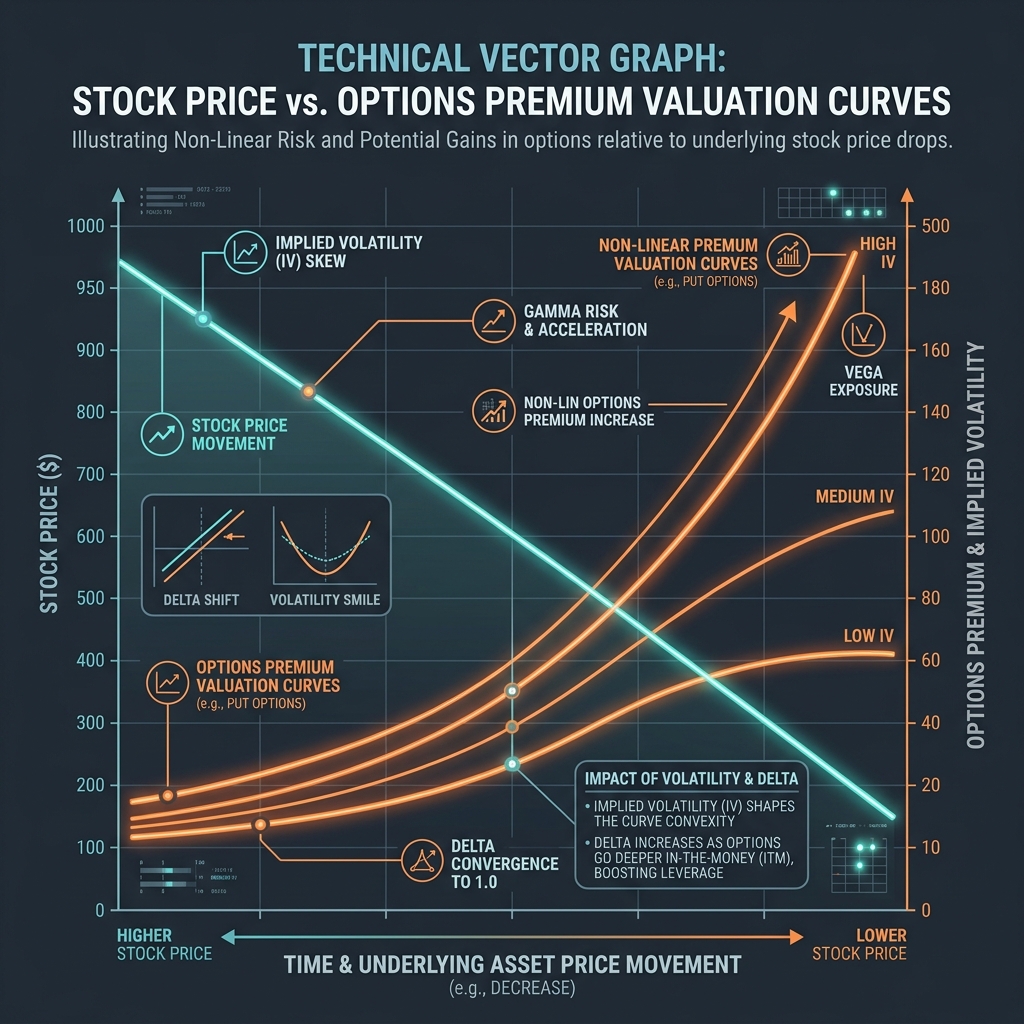
When sizing trades across options or leveraged derivatives, payoff curves are non-linear. The chart below illustrates how option premium delta decay curves shift based on implied volatility (IV) and pricing boundaries:
🔍 The Rule of Half-Kelly (Volatility Buffer)
While the Kelly formula is mathematically optimal, it assumes your win rate and payoff ratio are perfectly constant: * The Risk: Real-world trading suffers from variance. If you risk the full $f^ = 25\%$ calculation, a normal statistical run of losses will draw down your account quickly. * The Fix: Professional traders implement Fractional Kelly—most commonly Half-Kelly (allocating only half of the calculated $f^$, or 12.5% in the example above). * Fractional Kelly reduces volatility and drawdown depth while retaining over 75% of the growth rate of full Kelly sizing.
🛠️ Portfolio Sizing Utilities
To structure your portfolio risk: * Compare Sizing Models: Read Position Sizing by Max Drawdown Limits to cap equity curve variance. * Select Volatility Stops: Read Stop-Loss Multipliers Sizing Guide. * Compute Sizing Instantly: Use our browser-based Position Size Calculator to quickly model share counts and risk targets.
Join the Urbandigistore Hub
Subscribe to receive premium developer cheat sheets, advanced conversion techniques, and campaign optimization checklists. Zero spam, unsubscribe anytime.
🚀 Launch Interactive Tool
Ready to test this directly? Open the secure web tool in a new sandbox tab.