
Why Master Password Strength Matters: Calculating KDF Iterations Cost
Learn how Key Derivation Functions (KDFs) protect master passwords, and explore how iteration count increases security.
🔧 Interactive Utility Tool
Try the free, 100% secure client-side tool associated with this guide. No registration required.
Why Master Password Strength & KDF Iterations Matter
Securing user accounts requires state-of-the-art hashing algorithms and entropy measures. Here is how passwords are secured.
A cryptographic password is a secure key verified using hashing algorithms (like bcrypt) and unique random salt values. Checking password complexity entropy ensures the credentials resist modern high-speed brute-force attacks.
A zero-knowledge password manager keeps your credentials secure by encrypting your local vault with a key derived from your master password. However, because the server has no copy of your key, the strength of your master password is your only defense if your encrypted vault is stolen. To prevent hackers from brute-forcing vaults, developers use Key Derivation Functions (KDFs) to throttle decryption speeds.
In this guide, we'll explain how KDF key stretching works, analyze iteration costs, and review entropy metrics.
Product-Led CTA: Never reuse passwords or store them in unsafe web browsers. Generate high-entropy, cryptographically secure keys instantly using our secure, client-side Secure Password Generator.
⚡ Quick Action: Use the Online Tool
This guide pairs with our free, 100% secure client-side utility tool. Process your files or text instantly in-browser.
⚙️ Key Stretching: Appending KDF Time Costs
A standard hashing algorithm (like SHA-256) is designed to be extremely fast. A modern graphics card (GPU) can compute billions of SHA-256 hashes per second. If a hacker attempts to brute force a vault key derived with a single round of SHA-256, they will crack weak master passwords in seconds.
To prevent this, KDFs (such as PBKDF2-HMAC-SHA256) implement Key Stretching:
- Instead of hashing the password once, the KDF hashes the password hundreds of thousands of times (iterations) recursively.
- The OWASP Recommendation: Set the PBKDF2 iteration count to at least 600,000 rounds.
- The Throttling Effect: Running 600,000 rounds takes a user's device about $100 \text{ milliseconds}$ to decrypt the vault (which is unnoticeable). However, it forces an attacker's brute-force hardware to spend 600,000 times more computational power for every single guess, slowing their search to a crawl.
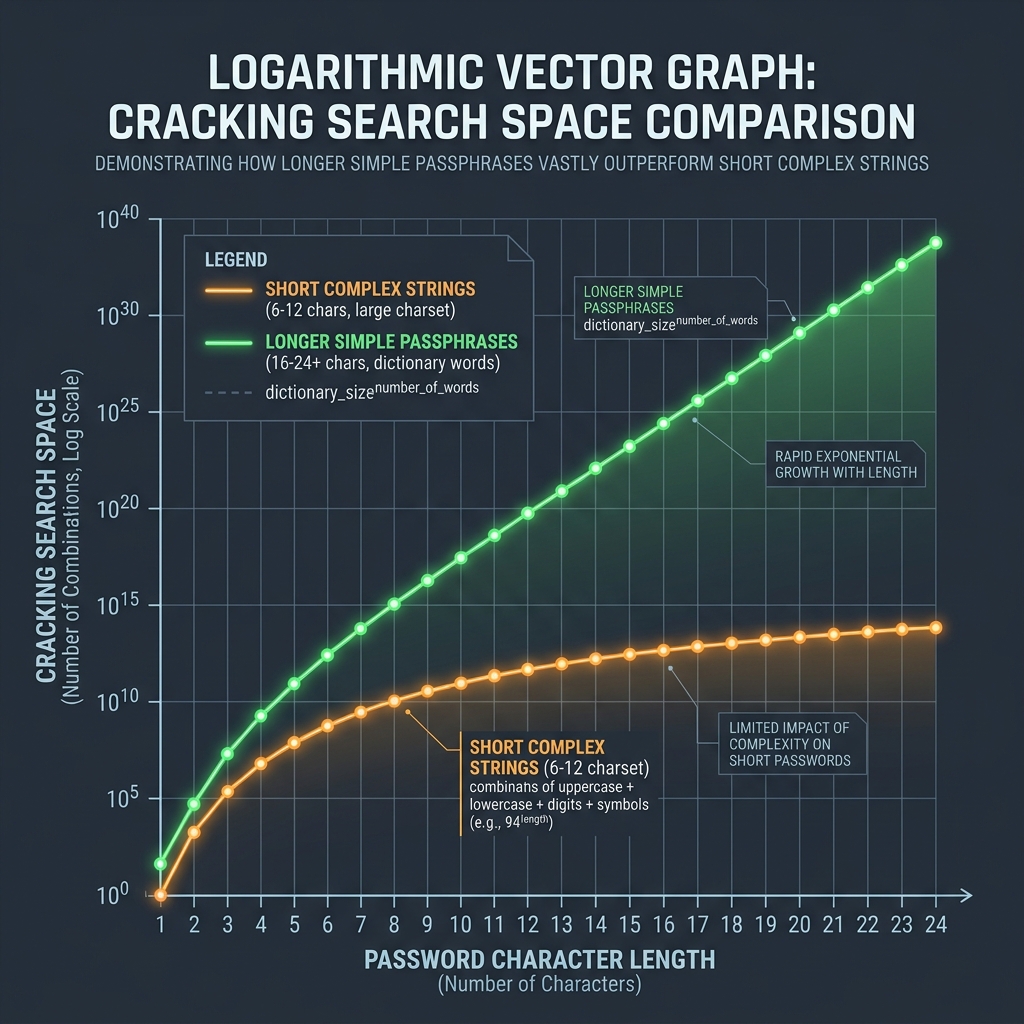
📊 Password Length and Entropy Reference
Because KDF iterations throttle cracking speeds, having a high-entropy password is even more effective. Refer to the logarithmic scale chart below to see how length scales cracking difficulty:
🛡️ Best Practices for Master Password Design
To ensure your vault is secure:
- Prioritize Length Over Complexity: Use a passphrase of 4 or 5 random dictionary words. This provides high entropy while being easy to type. (Read our Password Length vs. Complexity Proof).
- Prevent Dictionary Reuse: Never use phrases from books or popular media, which are indexed in attacker wordlists.
- (Read our Rainbow Table Salting Defenses Guide to review database protections).
- Generate High-Entropy Keys: Use our browser-only Secure Password Generator to create custom keys. Since all calculations execute in client-side memory, your keys are never sent to a database. (Read our Privacy Policy for data safety guarantees).
Join the Urbandigistore Hub
Subscribe to receive premium developer cheat sheets, advanced conversion techniques, and campaign optimization checklists. Zero spam, unsubscribe anytime.
🚀 Launch Interactive Tool
Ready to test this directly? Open the secure web tool in a new sandbox tab.